The Case for Preservation: The Weeks Hall Notebooks
“Henry Miller says you have wonderful pictures to illustrate a piece on ‘The Shadows.’” - Harry Ball [Town and Country Magazine] to Weeks Hall, February 11, 1941
William Weeks Hall returned to the Shadows in 1922 and began the restoration of his home and gardens that was competed in 1940. Once completed, he sought to secure the home’s future by bequeathing the site to the United States government. He submitted information about the Shadows that supported his case for preservation in a series of notebooks aptly referred to as the ‘Weeks Hall Notebooks’.
“…I own no other property but this place, which my great-grandfather built in 1830, and which is probably in the most perfect state of preservation of any plantation house in this state....In view of economic conditions which are now certain to arise, it would be extremely impractical if I were to ignore the future. I have made many sacrifices in order to restore the place with the utmost care for many reasons, with the sole idea of its eventual public use,” wrote Weeks Hall to Newton Drury, National Park Service Director, on December 21, 1941.
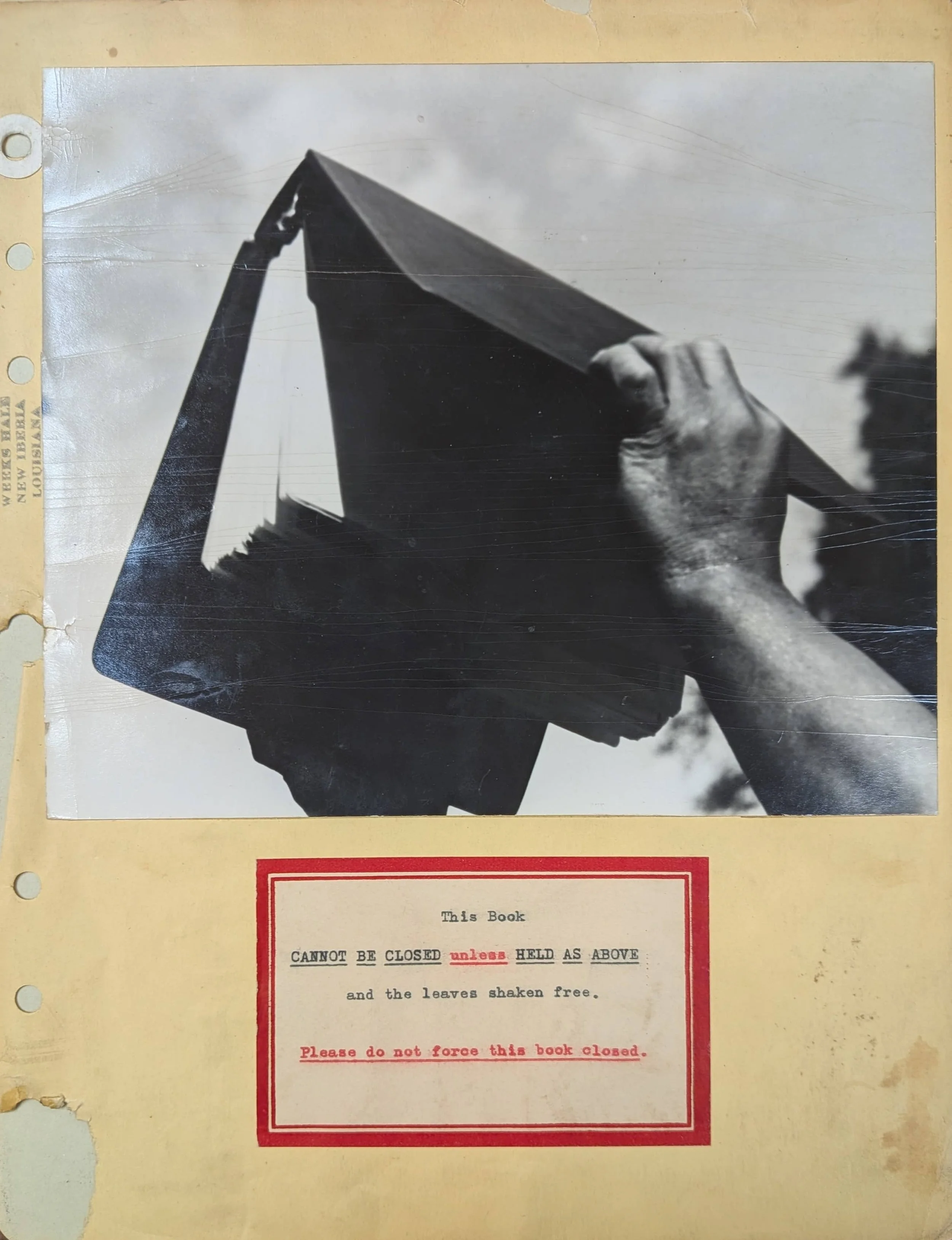
The last page of the Weeks Hall Notebooks, illustrating and providing directions on how to close the book.
From the collection of the Shadows-on-the-Teche
In support of his case for preserving the site, the Notebooks included many “wonderful pictures” that documented the home and gardens. These photographs, along with many typewritten pages recording each known detail about the site’s history, were sent to Dr. Vernon Tate, Chief of the Division of Photographic Reproduction and Research at the National Archives.
The Weeks Hall Notebooks are a rich resource about the Shadows and illustrate Weeks Hall’s attention to each detail involving his home and its preservation. In his letter to Dr. Tate, Weeks Hall identifies himself as: “the only person who has a complete knowledge of the history and contents of the house and grounds and considers this information worthy of preservation.”
Weeks Hall’s Notebooks not only provide insight about the Shadows, but also about the man who worked toward its preservation. His resolute effort towards this end is evident throughout the Notebooks and reminds one of a lawyer who has thoroughly proven his case. Despite this painstaking effort, the National Park Service turned him down. He later added new information to the notebooks and sent them to the National Trust for Historic Preservation. The Notebooks include supporting letters from experts. Historian Edwin A. Davis at Louisiana State University described the documents on loan to the institution, and architect A. Hays Town suggested the replacement cost of the Shadows. A historical background of the family is presented courtesy of W.G. Weeks and E. T. Weeks, Sr., sons of Charles Conrad Weeks. In the 1920s, due to their avid interest in family history, these attorneys had their secretaries transcribing documents.
Finally, the Notebooks conclude with articles covering the Shadows, architectural drawings, and a bibliography. But in typical Weeks Hall fashion, he also included a photograph and typed instructions on how to close the book.
The Weeks Hall Notebooks were the first time someone ever marketed the Shadows. With his magnum opus complete, Weeks Hall wrote to his friend, architect Richard Koch. “There are about one hundred and fifty pages and as many photographs. Every room from four corners, and close-ups of all detail. There are several photographs for comparison of the house from 1870 to 1940.”
In 1958, the National Trust succumbed to the onslaught of the Notebooks and Weeks Hall’s charm and accepted the Shadows as one of their historic sites.
Originally published in The Shadows Service League Newsletter, February 2000.
Edited by Adam Foreman, EdD, May 2026.