
Alfred Conrad Weeks, 1826–1864
"[C]ongratulations on the birth of another heir who I hope will be a source of honor and happiness to his parents."
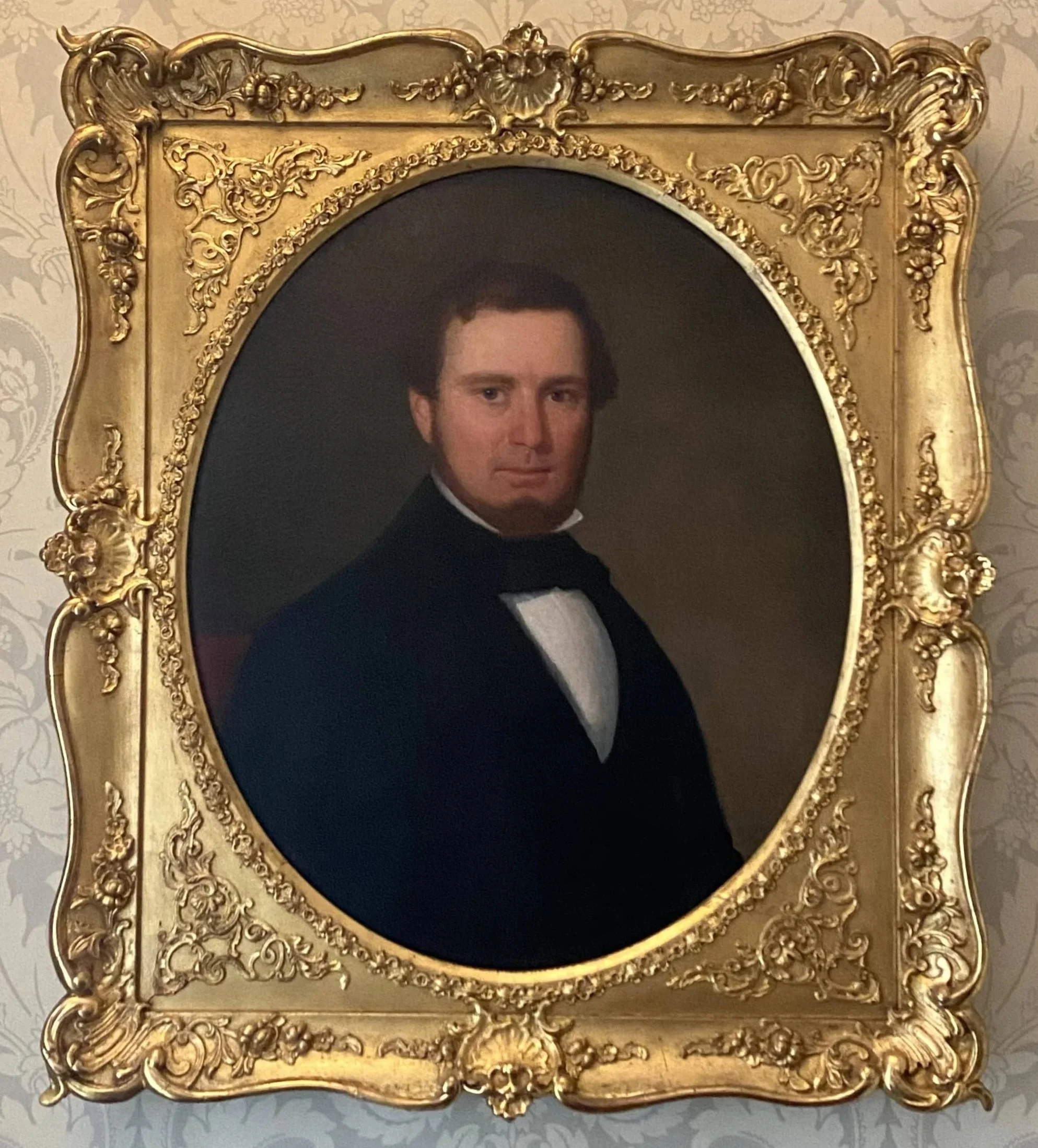
Portrait of Alfred Conrad Weeks painted by John Beale Bordley in 1845. NT.78.16.4
So wrote Frederick Conrad to his brother-in-law David Weeks on the birth of Alfred Conrad Weeks, April 26, 1826. The third child born to David and Mary Conrad Weeks, Alfred, nicknamed “Lap” or “Lappy,” grew up on the Weeks family plantation on the outskirts of New Iberia. Alfred’s childhood years were spent along the Bayou Teche, watching the new family home being built, one of the first brick structures in the area.
As an eleven-year-old boy, left at home while Mary and the other children went to New Orleans in March 1837, Alfred wrote the first letter we have by him in the Weeks Family Papers. In typical eleven-year-old fashion, Alfred jumps from one exciting bit of news to another—from telling his mother how good the apples and bananas were that she sent, to a long, imaginative story about “pirates” attacking family friend Boyd Smith’s ship carrying his sugar to market. The “pirate ship” with “six men & forty guns” turned out to be “an old provision boat,” but Alfred felt the story worth relating to his mother.
Alfred, along with three brothers and two sisters, attended their own school in the backyard of the Shadows with various tutors, including Mr. Stetson and Mr. Page. According to Alfred’s mother, “Lap” was “a favorite” of Mr. Page who “never saw A finer Boy,” and said he was “uncommonly smart,” and had “a dareing [sic] spirit.”
Alfred had another champion in his father’s half-sister, Rachel O’Connor, his “Aunt O’Connor,” who described Alfred at age ten as “a fine light hearted little boy…” Though many miles separated “dear Alfred” from his “Aunt O’Connor,” we know something of Alfred from her letters, which include a story of a goat-riding escapade at age ten.
By 1840, 14-year-old Alfred and his older brother, William Frederick Weeks, attended boarding school in Baton Rouge. A February 17, 1841, letter from Rachel O’Connor to Alfred’s sister Allie, mentions another side of Alfred. “He was formerly considered wild, but I now think him a most gentle and charming youth… I am almost glad that your Mama thinks of taking them to the North to finish their education, fearing they might fall into bad company in La.”
In 1841, after their mother’s marriage to Judge John Moore, the boys were enrolled at the University of Virginia in Charlottesville. On the day after Christmas 1841, Alfred wrote his sister Allie that he “had been very much sick of the University. I associate a great deal with ladies, a great deal too much for my own good.”
Possibly the reason Alfred was “fond of the University,” was because he was doing more socializing than studying. A letter to his stepfather, John, in early 1842 indicates that Alfred had not attended classes for the previous two months because, according to Alfred, his request for tuition funds had never been answered by his Uncle Charles Conrad.
Alfred transferred from the University of Virginia to Concord Academy in Lexington, Virginia in 1842. After eighteen months he wrote to his mother asking her advice concerning where he should study law. Alfred proposed either going to Cambridge in Boston or coming home to read law with his brother-in-law Augustin S. Magill. While Alfred assured his mother “I would rather go to any College in the United States than go back to the University,” 1844 found him “installed and studying hard” back in Charlottesville!
However, it was at the University of Virginia at the home of Henry St. George Tucker that Alfred renewed his acquaintance with Nannie Stephens Hunter and later married her on July 3, 1845.
Alfred,his bride, and her sister Fanny Hunter, came back to Louisiana where they first stayed with Mary and John at the Shadows before moving on to Grand Cote to share a house with Alfred’s brother William.
Their first child, Mary Evelina Weeks, was born in 1847 in New Iberia, followed by Fanny in 1848, and David in 1850, both at Grand Cote. By 1851, when Alfred Jr. was born, the family was living at a plantation called Belle Grove on the Bayou Teche between New Iberia and Jeanerette. Five more children were born to Alfred and Nannie between 1853 and 1862, one of whom died as an infant.
In 1850, Alfred sold his share of Grand Cote to his brother Charles for $3,000.
For some unexplained reason, Alfred wanted to move his family to Texas. “…I am anxious to visit Texas and should be country poor out at inviting I propose to build me a new house. I must live this life to have health and strength.”
Instead, Alfred remained on his Bell Grove plantation. ,During the Civil War, Alfred spent most of the time traveling back and forth between the Bayou Teche region and Texas, trying to keep the various family plantations going while also attempting to protect his movable property, his enslaved people, from confiscation by the Union Army.
Possibly due to poor traveling and living conditions caused by this transient existence, Alfred became ill and died at Belle Grove on December 23, 1864, “and on Sunday [Christmas day] we laid him beside his dear mother [on the grounds of the Shadows].”
The next year, Alfred’s widow, Nannie, and her children abandoned their estate near Jeanerette and moved back to Virginia. Alfred Conrad Weeks has no living descendants.
Originally published in The Shadows Service League Newsletter (Vol. 15, No. 4), April 1993.
Edited by Adam Foreman, EdD, April 2026.
