
"Fiery Orb to Freezing Fingers”: Coping with Climate in the 19th Century
What did 19th-century South Louisiana residents do to cope with the climate? Like today, there was much “grumbling about the weather” according to Mr. Brashear of St. Martinsville. (July, 1822) While there was much “grumbling,” they of course had no air conditioning, and Mary Weeks Moore was firm in her belief that “we cannot control the elements.”
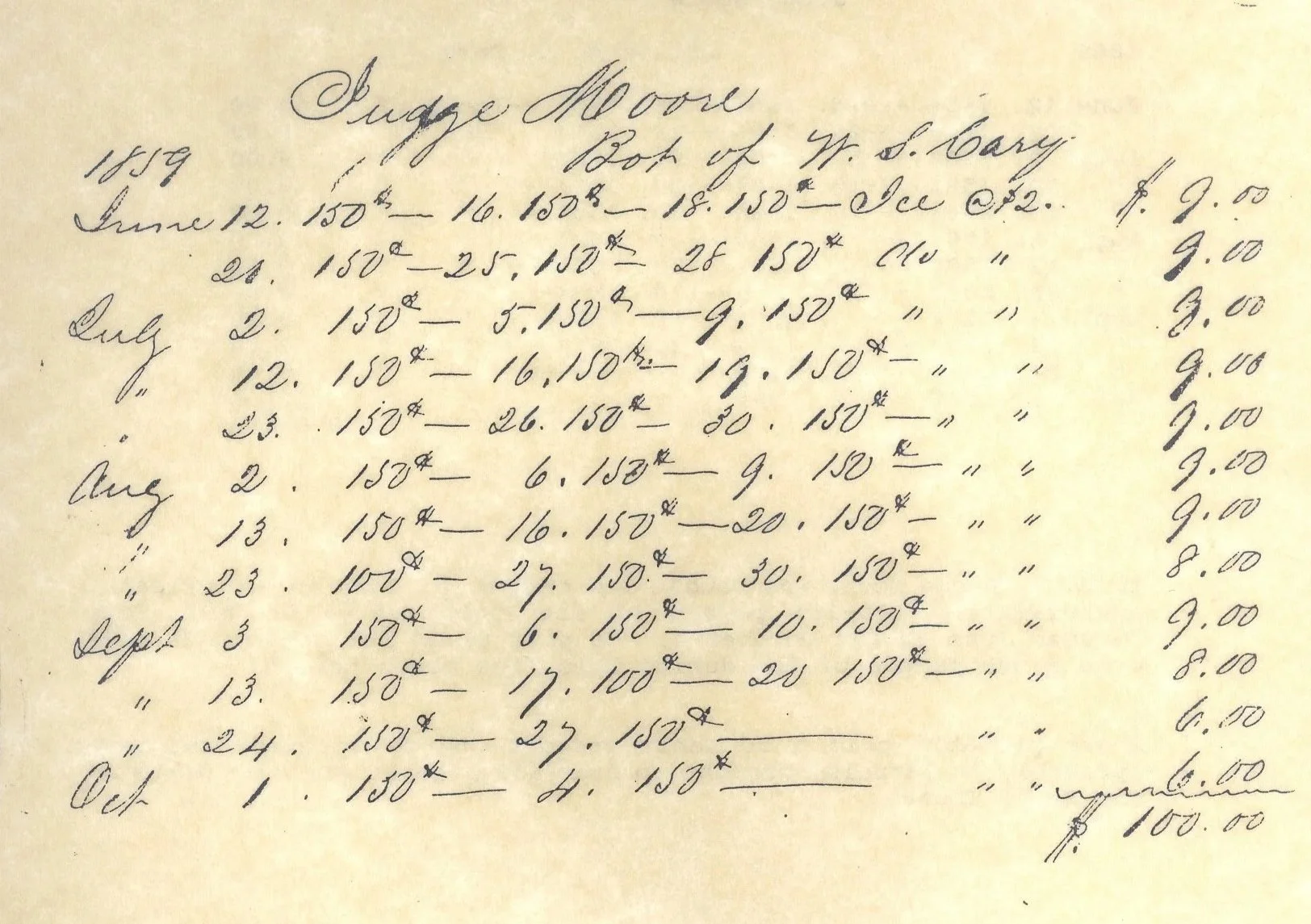
Between June and October 1859, John Moore purchased 5,000 pounds of ice from W. S. Cary in New Orleans at the rate of $2 per 100 pounds. The ice was then shipped from New Orleans to the Shadows.
From the archive of the Shadows-on-the-Teche.
Rather than control the elements, members of the Weeks family coped with the climate by adapting architecture, clothing, and lifestyle to suit the environment in which they lived. Houses were built to take advantage of cross-ventilation with lots of windows and doors and wide galleries to provide shade in summer and protection from blowing rain in winter. Cottons, linens, and light flannels were worn in summer, and wool and heavy flannels in winter. Bonnets, straw hats, and parasols protected the shaded face from the hot sun, while umbrellas, “great coats,” and beaver hats protected folks from the winter chill. Invoices for summer months included large quantities of ice, while barrels of coal were shipped in great numbers for the winter, augmented by frequent trips to the wood lots. Straw matting and light muslin curtains adorned the rooms during the hot season, while wool carpets and heavy draperies were used to hold in the warmth during the colder months.
There are many references to weather in the Weeks family correspondence, but usually rather than dealing with human comfort, the comments are made in conjunction with the crops. This is to be expected since the success or failure of the crop, and consequently the family fortune, depended on the weather.
But, interspersed among the comments about how the weather was helping or hindering the cane, are hints of how people’s moods were affected by the weather.
Nowhere is there a more eloquent description of the effects of a hot Louisiana summer day than Frederick Conrad’s June 28, 1835, letter from New Orleans to his brother Alfred in New Iberia.
“Every one seems to rise in the morning with his mind predetermined to make his way through the day as coolly and as calmly as the circumstances and the fiery orb above him will permit. And in spite of his deep resolve, the night finds him so wearied, his nerves in so shattered a state, and his blood coursing through his veins so like a boiling liquid, that he is almost tempted to think he has been perched for twenty-four hours directly over the Crater of Mount Etna.”
Frederick’s sister, Mary Conrad Weeks, a young, pregnant wife who had been left alone and isolated on the plantation for a month because heavy rains had turned the roads to mud and made it impossible to visit family and friends, wrote to him in July 1822 that the weather was “so gloomy that it gives me the horribles.”
Mary yearned to be outdoors. She loved gardening, but when winter rains kept her from going outside in January 1853, she complained to her husband, John Moore, “I have read everything about the house. I wish there was A good Library in this place, in dark bad weather when I cannot go in the Garden time hangs heavy on my hands.”
For a sense of what a rainy January day was like in the Shadows without electric lights to disperse the gloom, we can read Mary’s 1862 letter to John: “…it is a cold, gloomy, damp day. I can not scarcely see to write or read at the fire… The weather is so dark and gloomy it depresses my spirits.”
While winter in southern Louisiana didn’t last long, it did occasionally get very cold, and it is very apparent that coal or wood-burning fireplaces did not always provide sufficient heat. Charles Conrad excused the shortness of a letter written in November 1832 to the fact that “my fingers are almost frozen.”
Hot or cold, wet or dry, gloomy or bright, we may no longer write to each other about the weather, but it certainly is an important topic of daily conversations. Then as now, it is as Mary once wrote, “we poor mortals must have something to murmer [sic] about.” Maybe the “grumbling” and “murmuring” are how “poor mortals,” both 19th-century and present-day, best cope with this climate!
Originally published in The Climate Courier: “Fiery Orb to Freezing Fingers” Exhibit Newspaper on August 8, 1992.
Edited by Adam Foreman, EdD, April 2026.
