
Mary Clara Conrad: A Biographical Sketch
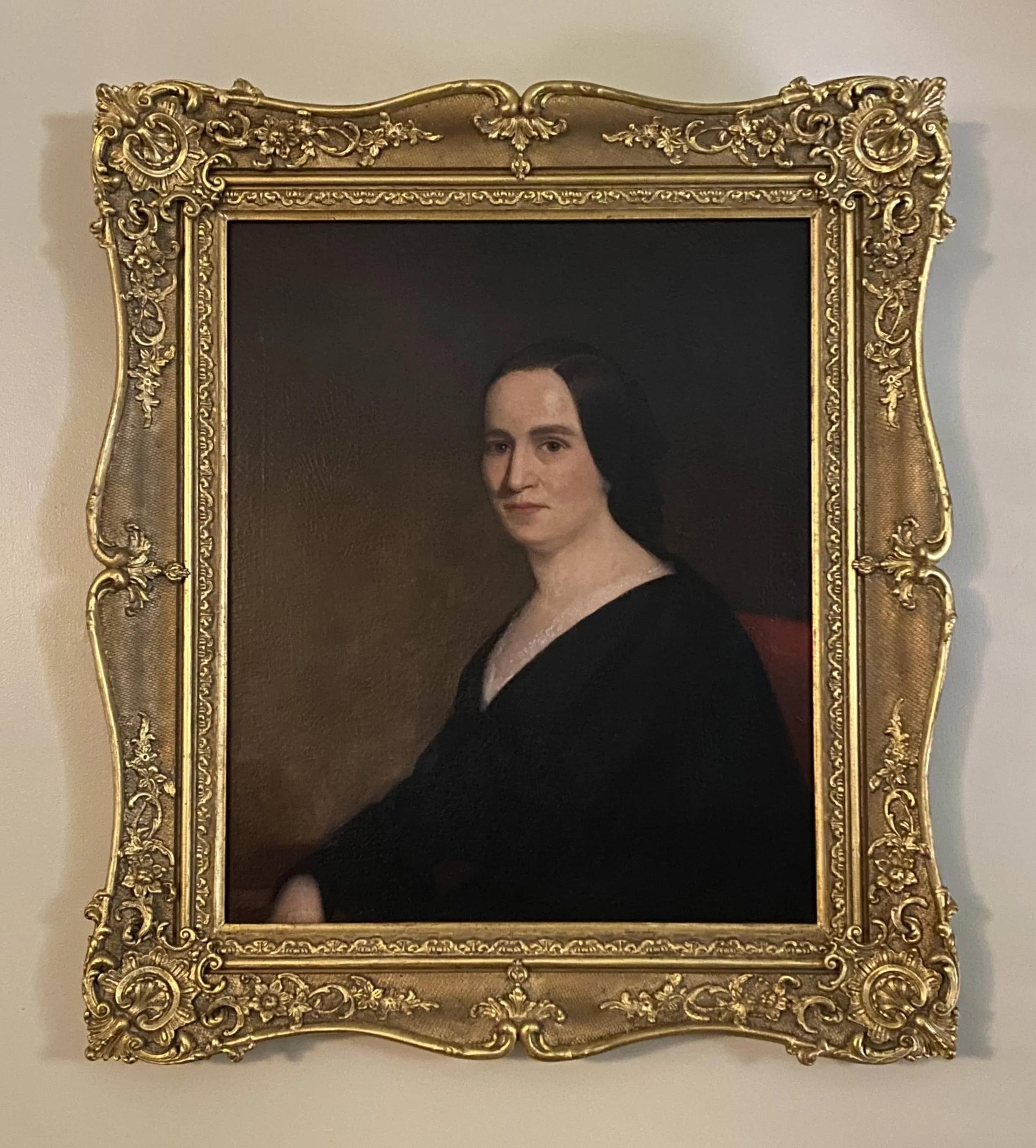
Portrait of Mary Conrad Weeks Moore painted by John Beale Bordley in 1845. NT59.67.542
Mary Clara Conrad, named after her paternal grandmother, was born in 1797 in Winchester, Virginia. Her parents, Frederick and Frances Thurston Conrad, married in 1793. At the time of Mary’s birth, her father operated a tannery inherited from his father. Frederick Conrad moved his family from Winchester to the Natchez, Mississippi area around 1805, which is where Mary, along with her brothers and sisters, attended school.
By 1808, the Conrad family lived on a plantation on the Bayou Teche between New Iberia and Jeanerette. This was likely Rosedale, the home of Mary’s maternal grandmother, Ann Thurston. Mary’s mother died there in 1813, leaving a husband and eight children: Ann, Mary, Frederick, Alfred, Charles, Sidney, Frances, and Frank, ranging in age from about 3 to 18.
In the midst of an active social life, Mary and her older sister, Ann, met and were courted by two planters. In Franklin in October 1818, Ann married John Towles, a doctor, plantation owner, and widower with children. Two months later, on December 31, Mary wed David Weeks at the home of John and Ann Towles. Based on their sisters’ success in making such good marriages, the Conrad brothers jokingly named the Attakapas the best county for marrying!
Mary was twenty-one when she married David Weeks, aged thirty-two. For the first year of their marriage, they lived near St. Francisville before moving to a plantation on Bayou Parc Perdu in St. Martin Parish where they built a house and had the first of their eight children in 1822.
Mary was proud of her house at Parc Perdu and very happily enlisted her brother Alfred Conrad’s help in acquiring draperies for the dining room. She also quickly set to work putting in a garden. But within four years, David was ready to make another move and after purchasing land in New Iberia, he sold Parc Perdu and Mary had to leave behind her new house and lovely garden.
From 1825-1834 when the Shadows was completed, the family lived on the Bayou Teche and increased in number to seven. Frances and William were joined by Alfred, Allie, Frederick, Charley, and David. The sugar plantation on Grand Cote [Weeks Island] was doing well, and the new brick house was going up slowly.
Unfortunately, David Weeks’ health was not doing as well as his plantations, and trips to the northeast and visits with numerous doctors failed to bring any relief. David died in 1834, leaving Mary a widow with six children, a new house, and several plantations.
From 1834 until 1841, Mary kept extremely busy with young children and the management of the plantations. Brothers Frederick and Alfred advised and assisted her, but she often directly oversaw events. She was diligent in seeing to the education of her children. Mary was also responsible for the needs of the enslaved people on Grand Cote and the home place—almost 300 men, women, and children. This meant making sure there was sufficient food and adequate housing for everyone, and that when medicine was needed, proper treatment was administered.
In 1841, her life changed with her marriage to John Moore who was then able to share some of the burden. While they signed a marriage contract keeping their respective properties separate, Mary relied on her husband for advice in business and family affairs.
By 1844, William took over the management of the family plantations. The children began getting married with Frances’ 1841 marriage to Augustine Magill. Alfred married Nancy Stephens Hunter in July 1845, and Allie married Dr. David Meade later that year in September. The following July, William wed his cousin Mary Gorham Palfrey, leaving only Charley at home until he married Margaret Glassell in 1857.
(Click on image to view at larger size.)
The 1840s and 1850s were good decades for Mary. She watched her children mature, marry, and have children of their own. Her marriage to John Moore was a good one, and she and her husband were respected members of the community. The plantations were doing well and the family’s future looked secure. Of course, that is not to say that there were not sad times too. Death came often, but then death was a frequent visitor in the 19th century. . Between 1840 and 1850, Mary lost two children, David and Frances. During those same years she buried nine grandchildren.
The 1860s were harder for Mary. The absence of her husband, who was a member of the Louisiana Confederate Government, created a sense of abandonment that must have been more acute when her home was surrounded by Union troops in the fall of 1863. She prayed for the safety of her husband and children and looked forward to the time when the war would be over and they could again be together.
The evening of December 28, 1863, found her in good spirits having just received a letter from her long-absent husband stating he was well. This good news enabled her to “laugh at the Yankees,” enjoy her evening meal, and pick up a new novel to read herself to sleep. Sometime in the early hours of the morning of December 29, 1863, Mary died peacefully in her sleep and was laid to rest in her garden.
Originally published in The Shadows Service League Newsletter (Vol. 14, No. 7), July 1992.
Edited by Adam Foreman, EdD, March 2026.
