
Weeks Hall: Mardi Gras Celebrations Big and Small
In early January 1956, Willian Weeks Hall prepared to “write a letter” on tape to his friend Frederick Rath with the National Trust for Historic Preservation. Clement Knatt, who at that time had worked for Weeks Hall for twenty years, was called on to serve as the “sound engineer” [in Weeks Hall’s words] and operate the tape recorders as Weeks Hall put his thoughts into words. He began the tape by commenting briefly on a Louisiana phenomenon not familiar to his northern friend.
“Twelfth Night or January 6, 1956. The carnival season during which all hotels are packed at advanced prices begins tonight and ends with Rex on Shrove Tuesday the day before Ash Wednesday. Incidentally, all these years of my incapacities I’ve been receiving invitations to both of these balls [Rex and Comus?]. I haven’t been to a Carnival ball in twenty-five or thirty years. But the city is a madhouse as far as traffic and mix-ups are concerned during the season.”
Mardi Gras, or Carnival as Weeks Hall called it, was apparently a special holiday for him. While he deplored the traffic and the “madhouse” atmosphere of carnival in New Orleans by the 1950s, in earlier years Weeks Hall had enjoyed being in the city during this festive time. He attended balls, private parties, and was a spectator at parades. According to Clement Knatt, who accompanied Weeks Hall to New Orleans for the Carnival season many times, Weeks Hall chose to stay at the Monteleone Hotel in the French Quarter even at “advanced prices.”
It wasn’t only the partying and good times which attracted Weeks Hall to the Carnival season, but also the color and the spectacle presented when everyone in the city of New Orleans turned their attention to celebrating Mardi Gras.
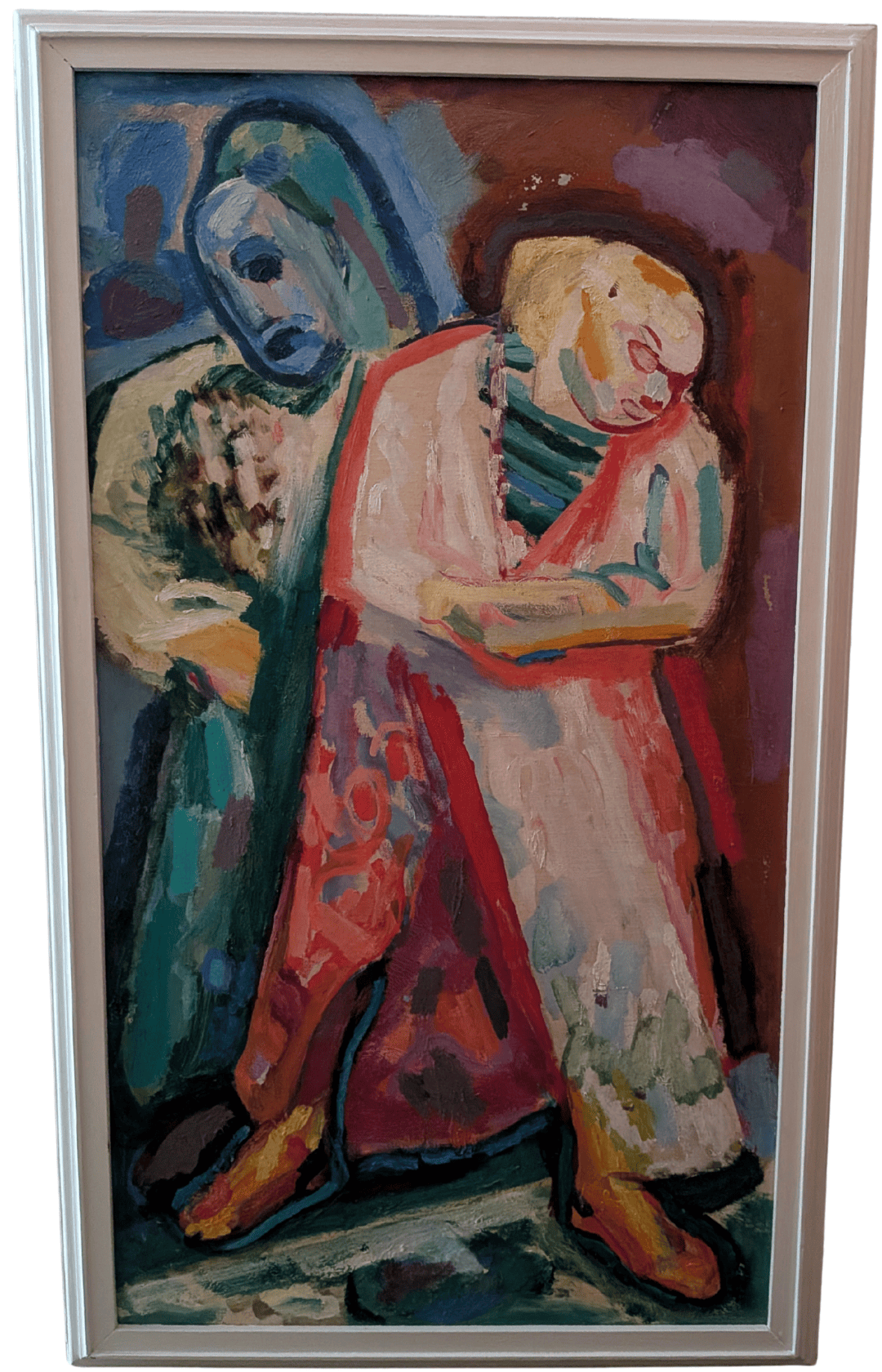
Maskers in Sunlight by William Weeks Hall.
NT 59.67.413
As an artist, Weeks Hall tried to capture the excitement both in his paintings and later in photography. In 1939, Weeks Hall painted a bright, colorful oil painting which he called Maskers in Sunlight. This painting was exhibited at the Arts & Crafts Club Sales Gallery on Royal Street in February 1941, and was available for purchase at a price of $60.00. Still in our collection, research indicates this was only one of several paintings by Weeks Hall devoted to Carnival.
Possibly in the late 1930s or early 1940s, on another trip to New Orleans for the Carnival season, Weeks Hall captured the feel of Mardi Gras by photographing numerous imaginative floats with krewe members in colorful costumes and masks. He used the relatively new Kodachrome film to produce some truly remarkable color slides now in the Shadows Collection. Floats pulled by mules, red devils dancing and waving their gold pitchforks in the air, Uncle Sam standing tall on a red, white, and blue float, and a polar bear amidst the ice of an arctic cave—all the color and pageantry of Mardi Gras in New Orleans are seen through an artist’s eyes and preserved by his camera.
But Weeks Hall’s interest in Mardi Gras was not restricted to the elaborate festivities in New Orleans. New Iberia residents Johnny Holbrook and Aline Compton Porter recalled some very special Mardi Gras parades of their own.
On a Mardi Gras morning in the early 1930s, a group of youngsters from the neighborhood of the Shadows gathered on the steps of the Compton [now Porter] house on St. Peter Street. Eighteen or twenty in number, they had outfitted themselves in costumes and masks made by their mothers. This creatively dressed group of cowboys, soldiers, and clowns proceeded to march around the block to Main Street where they approached the east gate leading into the Shadows. Standing at the gate, ready to admit the maskers onto the grounds was Theophile Viltz who worked for Weeks Hall. Weeks Hall took as much delight in seeing this parade of the children of some of his New Iberia friends as he did in any of the New Orleans Marid Gras parades he attended.
Originally published in The Shadows Service League Newsletter (Vol. 16, No. 2), February 1994.
Edited by Adam Foreman, EdD, February 2026.
