
Christmas Celebrations in the Antebellum South
Judge John Moore’s granddaughter, Adelaide Prescott, called “Addie” by her grandfather, wrote her memories of an early Christmas, circa 1851: “When I was about seven years old Henry Bassett [a family friend from a nearby plantation] used to make quite a pet of me. On Christmas Eve of that year, he rode his horse into the yard and on finding our head nurse, Mere Rose, he gave her a small package to place under my pillow that night, and as he dashed out with only a greeting of his hand to me on passing, I wondered much why he did not give his usual salutation, but was reminded of the stirring times of Christmas, and did not know until morning that the fleeting visit was to give me a beautiful gold stud with an emerald and small diamond, which was much in use at that time. Mere Rose was not long in calling my attention from my stocking to my pillow where underneath was hid the beautiful gift. O’ this was a joyful Christmas and the last that should see the united family, for my brothers Ben and Lewis were sent off to Virginia to attend Mr. Ben Hallowell’s school in Alexandria...”
A “gold stud with an emerald and small diamond” does not appear on the lists of Christmas gifts for children found in many 19th-century documents. Fireworks were popular with children of all ages, and other toys found in stockings or under the tree or pillow might include jack-in-the-box, pull toys, balls, building blocks, drums, jigsaw puzzles, a game called “Snakes and Ladders,” and, of course, dolls. Gift shopping for the Weeks and Moore families was likely done in Franklin or New Orleans or even stores in New Iberia by the 1840s-50s.
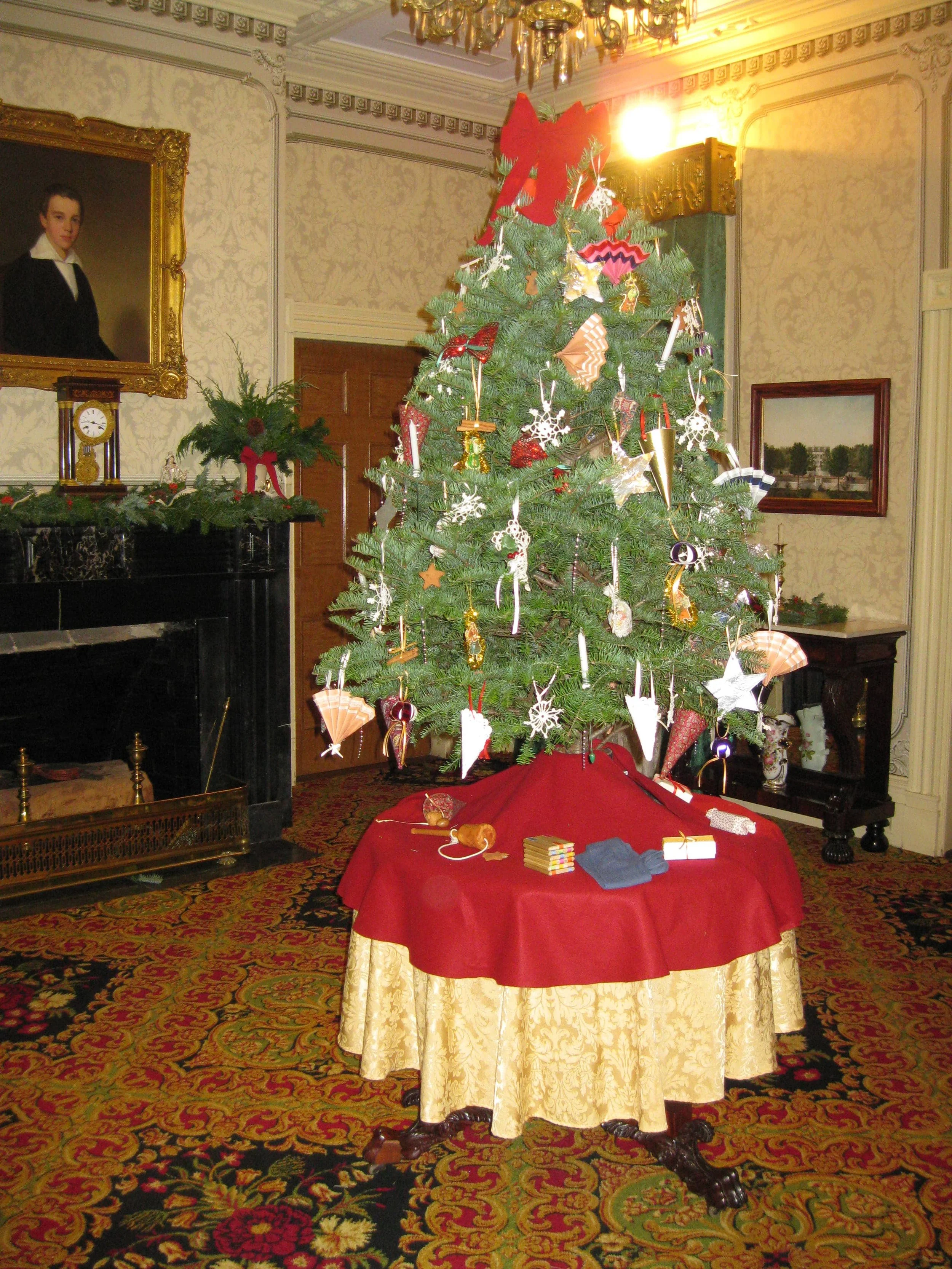
In decorating the Shadows for the holiday season in 2011, reproductions of antebellum toys and hand wrapped gifts were placed under the Christmas tree in the parlor.
In addition to toys, Christmas stockings, and Christmas trees, Christmas was celebrated in other ways. In nearby Franklin the children held a parade on Christmas Eve in 1847. The parade was written about in the Planters’ Banner which described how the children paraded through town, “the first child carrying a cross, and following in order, a turkey, the Boar’s head, the wassail bowl and Yule log. After the parade the children marched to the Methodist Church which had been decorated with Christmas greens...” When they arrived at the church “a strong-minded lady member” refused to allow the children inside because they were going to use a fiddle in their program. The children went on to the courthouse where St. Nicholas “handed out presents to all.”
For those individuals enslaved on the Weeks family plantations, the Christmas season coincided with the grinding season, which meant longer hours each day and working seven days a week until the sugar crop was processed. The end of harvest usually brought a “frolic” with lots of special foods such as pies and cakes, roast turkey and ham, and dancing in the sugarhouse. Since the end of harvest and Christmas were usually close together, the frolic was essentially a celebration of both events. For the frolic, food and drink were provided by the Weeks family. On January 28, 1859, Allie Weeks Meade wrote to her mother, Mary Weeks Moore, saying “Amanda is busy to day making pies, cakes &c. For the people who give a supper tomorrow night at the lower place. They have a wet time for their frolic, but I suppose they will enjoy a supper and dance in the sugar house. I have given them ten geese, a hog and shall have a lot of cakes and pies made for them.” Enslaved men provided the music for the frolic. At the plantation on Grand Cote, Sampson played a fiddle and was likely accompanied by banjos and drums.
“...I have made arrangements to let the negroes have a frolic on Christmas.” – William Frederick Weeks to Mary Weeks Moore, December 22, 1855
Enslaved individuals were also often given several days off during the holiday season. This time was spent traveling to other plantations to visit family and friends, attend religious revival meetings, or earn money selling handmade items or produce at market.
Apart from all the firecrackers, toys, and parades, Christmas in the 19th century was a religious holiday when family and friends gathered at their church, decorated in “Christmas greens,” and then made their way home for a special Christmas dinner of turkey, oysters, sweet cakes, and many other delicacies only found on the table at Christmas. The Weeks Family Papers indicate items ordered around mid-December, presumably for the family’s Christmas celebrations, include preserves and jams, fresh fruits such as apples and cranberries, salmon, spices, large quantities of butter, tea, coffee, candies, and an assortment of liquors. Many a cup of wassail and eggnog (laced with brandy) were raised as family and friends toasted the holiday and prepared for the fast-approaching New Year.
Originally published in The Shadows-on-the-Teche Newsletter (Vol. 10, No. 12), December 1988.
Edited by Adam Foreman, EdD, December 2025.
