
Profile on Spot, a “Most Companionable Setter”
“The thing I was most conscious of was the intelligent courtesy. Only Spot and the Man were here to welcome me, but I feel they reflect perfectly the character of the owner. A Visitor.”
[The Shadows Visitors’ Book (1936-38), September 14, 1937 entry. “the Man” was probably Theophile Viltz]
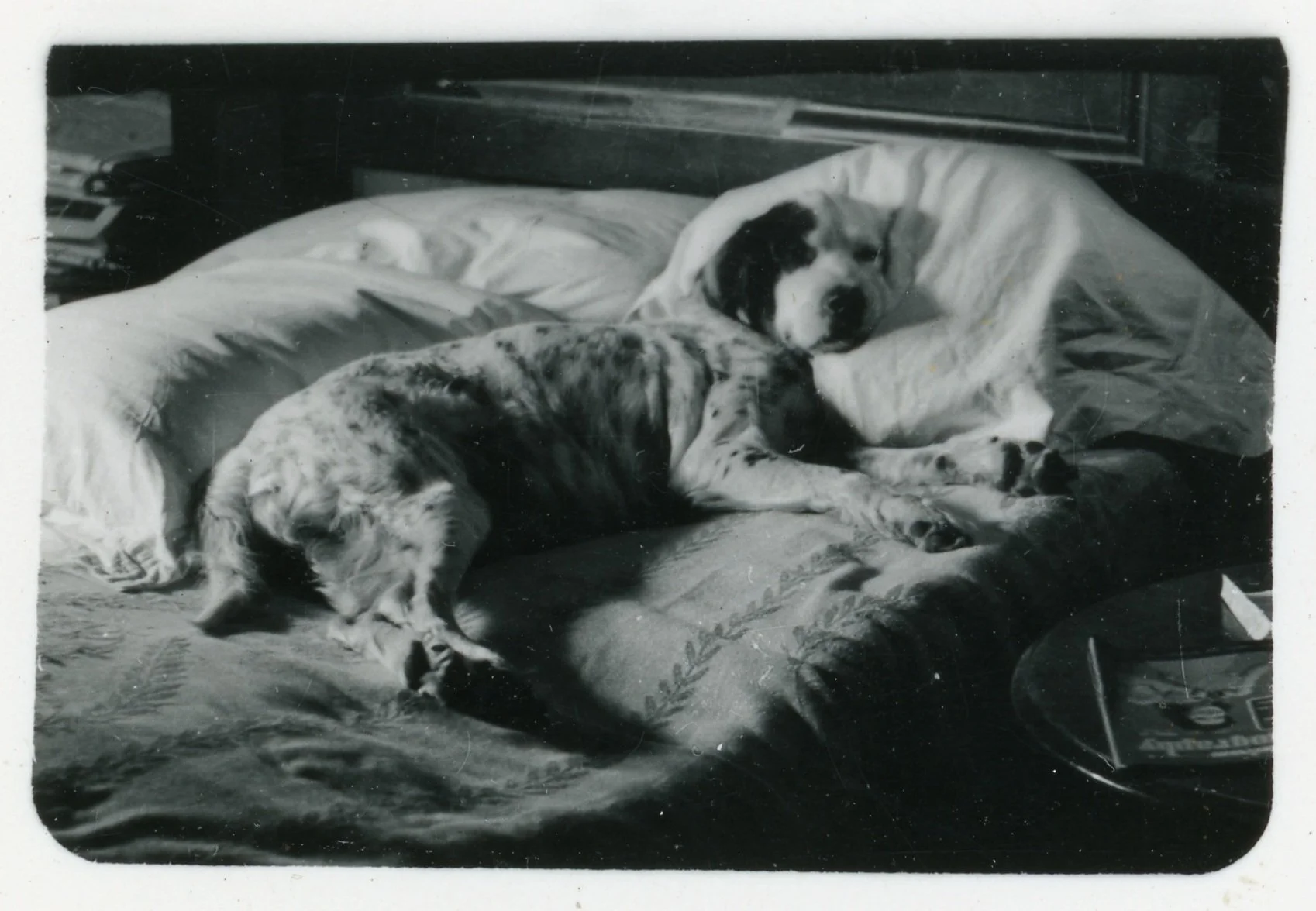
Spot laying on Weeks Hall’s bed.
From the collection of the Shadows-on-the-Teche.
Throughout the 1930s, visitors to The Shadows, anonymous or otherwise, remembered their visit not only on account of the beautiful house and gardens, or the charm or eccentricities of William Weeks Hall, but sometimes due to a very special dog named “Spot.”
Spot, a beautiful English Setter with the pedigreed name of “Lady Shadows’ Ghost,” was born on June 23, 1931. A year later, Spot was photographed with Weeks Hall for an article by Dean Tevis in The Sunday Enterprise, a local newspaper. “Lady Shadow’s Ghost, at the climax of a brilliant puppyhood, …descendant of Eugene’s Ghost the great English setter, a magnificient [sic] newcomer to the Shadows, is the epitome in silken black and white of the gorgeous home and the exquisite grounds….”
One of Weeks Hall’s famous visitors, Henry Miller, also recognized Spot’s importance, dedicating a portion of the chapter on “The Shadows” in his book The Air-Conditioned Nightmare to this remarkable dog.
Miller wrote that the ten-year-old Spot had “absolutely human eyes. … She looks at you with the soulful eyes of some departed human who has been condemned to crawl about on all fours in the body of this most companionable setter.”
Weeks Hall, on one of his audiotapes recorded in 1954, remembered Spot as “a beautiful, highly-bred, English setter,” but Miller had much more to say about the “unholy sort of bond between” dog and master. Weeks Hall argued that Spot, though referred to by such a common name, was a very uncommon animal with “beautiful manners—the manners of a lady.” Weeks Hall believed Spot didn’t like other dogs, and that she in fact didn’t think she was a dog.
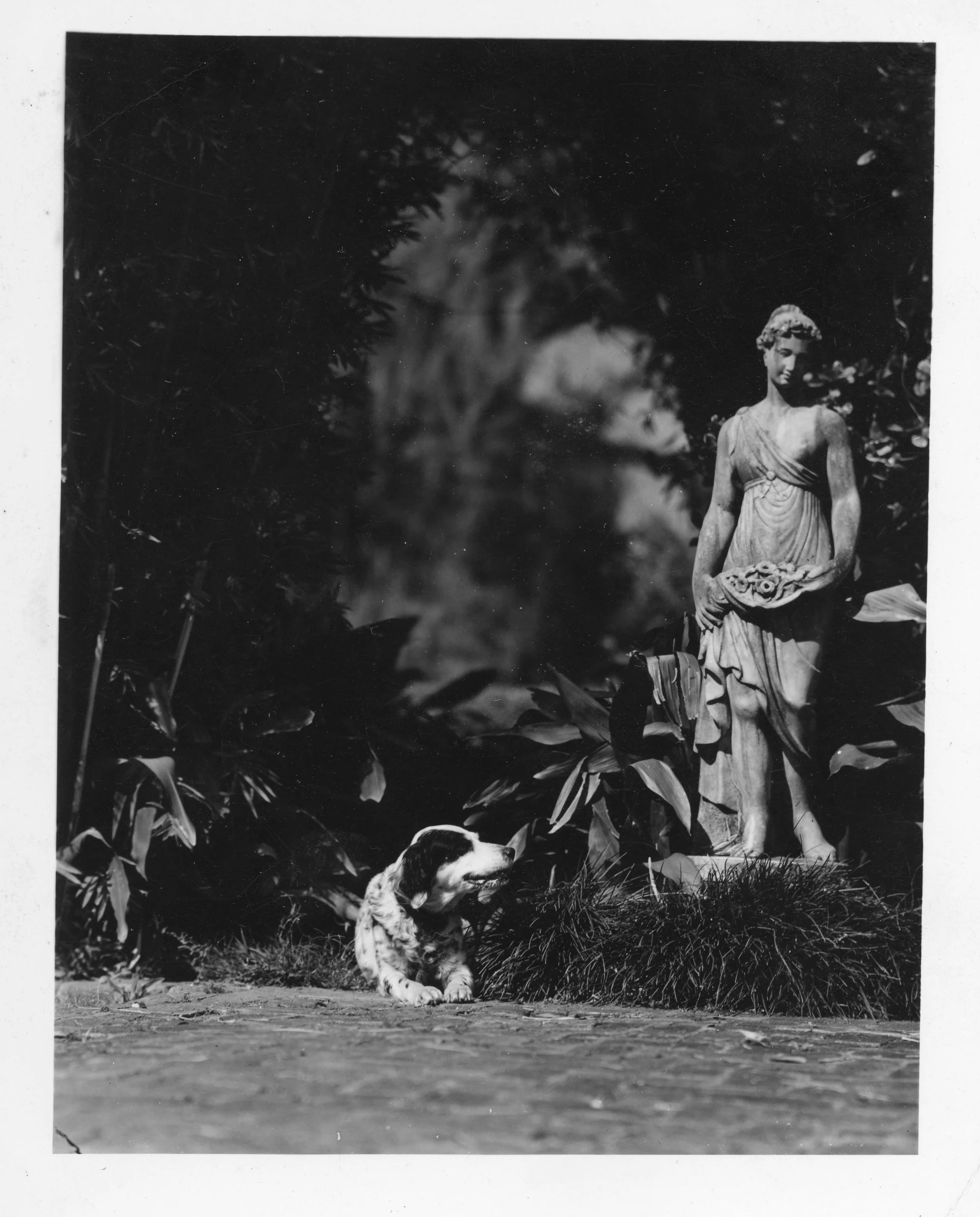
Spot laying in the formal gardens of The Shadows near the statue of Spring.
From the collection of the Shadows-on-the-Teche.
Weeks Hall told Miller in what must have been a rather lengthy discussion on the matter, that Spot was “sad because of her inability to speak…” Miller, having watched Weeks Hall and Spot walking about the garden, sharing a cup of coffee, thought differently. Miller believed “she was sad because nobody except her master had the intelligence to recognize her as a human being and not just a dog.”
During the Spot years, another well-known visitor to The Shadows was the jazz musician and world-famous trumpet player, Bunk Johnson. Johnson worked for Weeks Hall as a yardman in the 1930s and formed his own special bond with Spot. Johnson told Weeks Hall that Spot was “too much of a lady to be fed canned dog food,” and began each work day by cooking a breakfast of hash, “perfectly seasoned,” yellow grits, and black coffee, which he shared with Spot.
Spot was photographed many, many, many times by Weeks Hall. There are over a hundred snapshots of Spot from puppyhood to adulthood in The Shadows’ collection. Years ago, a visitor shared he had photographed The Shadows in the 1930s, and that Spot was so accustomed to being photographed, that when she saw his camera, she immediately went to pose at the foot of the stairs!
“Lady Shadows’ Ghost,” better known as “Spot,” died April 7, 1943, in Weeks Hall’s room. She is buried under the clump of aspidistra near the family cemetery in The Shadows gardens. She had at least one litter of puppies in 1935, but it is unknown if or how many descendants she might have.
Originally published in The Shadows Service League Newsletter (Vol. 18, No. 6), June 1995.
Edited by Adam Foreman, EdD, May 2026.
