
Summer in Louisiana is hot! Summers 150 years ago were also hot, and the Moore and Weeks families didn’t have air conditioning and frozen yogurt stands, so what did Mary Weeks Moore and her family do to keep cool?
First, they built their houses to take advantage of every natural means of staying cool in a hot and humid climate. The Shadows was built on a natural bluff overlooking the Bayou Teche. The many windows and doors opened onto wide galleries to make the home “delightfully light and airy.” This allowed fresh breezes from the bayou to circulate freely through the family’s living quarters, located on the second floor of the house.
Secondly, Mary and her family kept their households supplied with ice during the hottest months of the year. Ice was brought to the Shadows by steamboats on the Bayou Teche and overland by train. For shipping, ice was packed in small crates or cloth sacks.
The ice was shipped from New England where a family named Tudor started an ice export business in 1805. By 1819, the Tudors were shipping ice to Charleston, Savannah, and New Orleans. The Tudors’ business became more profitable after Nathaniel Wyeth invented an ice cutter in 1827. Wyeth’s new ice cutter looked like a plow with a saw-toothed blade. Pulled by a horse across a frozen pond, the blade cut blocks of ice which were then broken out of the pond and packaged. This greatly increased the volume of ice that could be harvested and reduced its cost.
Of course, storing the ice after harvesting was equally important, and as early as 1803, Thomas Moore of Maryland patented a home ice chest which consisted of “a double-walled wooden box, insulated with charcoal, or ashes between its walls, and with a tin ice holder inside, near its top.” These same principles were later used to build ice houses to store ice for summer use, and combined with the Wyeth ice cutter, “reduced the price of ice 60 percent.”
Recognizing the potential market in southern states for ice, the Tudors and Wyeths developed more efficient methods of transporting their “fragile” product. These methods ranged from wrapping blocks of ice in sheepskins and sealing it in tin boxes to stacking the slabs of ice between planks and using it as ballast in sailing ships. It was Nathaniel Wyeth who “insisted the ice be packed closely in the hold of the ship, trimmed to conform to the curve of the hull, and packed with 6 to 12 inches of dry sawdust, shavings or straw on all sides of the ice allowing no air spaces between. The hold was then caulked closed and not opened until destination was reached.”
While the Tudors were successful in introducing their product to islands in the West Indies where ice was used in the fight against fever, the first shipment of ice to New Orleans was not welcomed. A newspaper account from 1820 describes a New Orleans version of the Boston Tea Party with just a few changes. The mayor of New Orleans and other concerned citizens marched to the river and dumped the recently arrived cargo of ice into the Mississippi claiming, “iced drinks chill the innards and make consumptives of those who drink them.”
Mary may have applauded their actions for when David Weeks, her first husband, was sick in New Haven, Connecticut, in 1834, she begged her brother Alfred Conrad to see that David resisted all temptation to drink anything cold because “cold water and cold drink are very injurious to him.”
By the 1850s, it seems Mary may have changed her mind about the dangers of ice consumption. In 1854, she purchased a “Refridgerator [sic]” for $14 from W. S. Cary of New Orleans, and that same summer she received a cask of ice every three to four weeks by steamboat from New Orleans at a cost of $2.50 per cask. Of course, she may have been using the refrigerator and ice to preserve foodstuffs rather than to have “cooldrinks.”
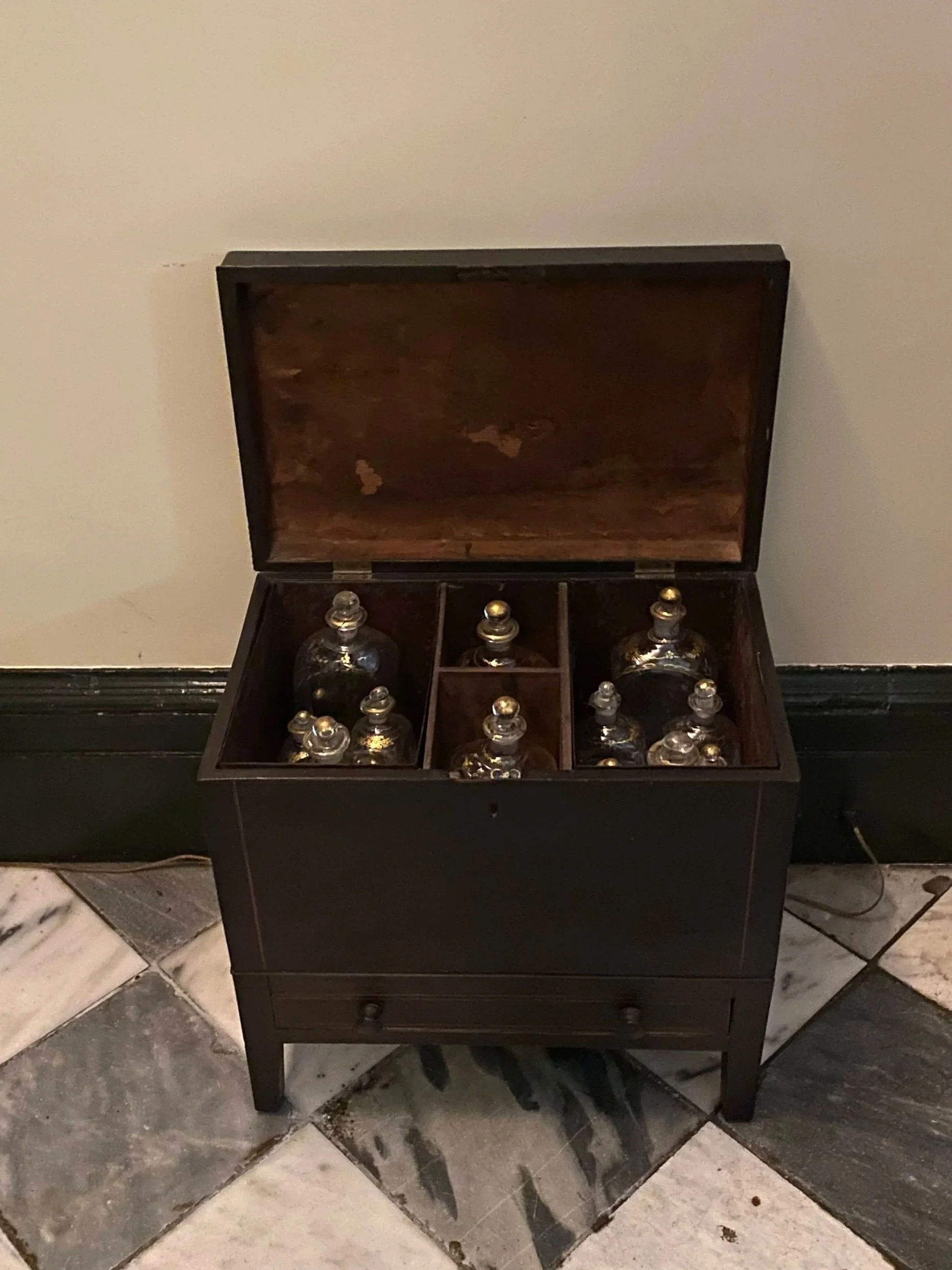
The cellarette on display from the Shadows’ collection has tin-lined compartments for keeping bottles cool and a tin-lined drawer to collect water as the ice melts and drains through holes in the bottom of the compartments.
NT 59.67.78 (A-C) & NT59.67.180 (A-L)
An ad in a New Orleans newspaper on November 18, 1858, describes the advantages of having a refrigerator, especially the “improved” model being sold by Flint and Jones. “Refrigerators, Improved Galvanized Iron Refrigerators on scientific and practical principles…use for cooling and preserving meats, milk, butter, fruit, wine, etc….Ice Water container…Flint and Jones 44 and 46 Royal St.”
For those who didn’t find a “galvanized iron refrigerator” aesthetically pleasing, cellarettes of mahogany and other fine woods were made with compartments lined with tin which could “contain several pounds of ice with wine, fruit, water and other such items as required cold.” These cellarettes could be placed in the dining room, family sitting room, or even in the parlor. The cellarette at the Shadows not only has the tin-lined compartments but also has a tin-lined drawer beneath to catch the water as the ice melts and drains through the holes in the bottom of the compartments above.
As methods of harvesting and shipping ice improved, and better means of keeping ice became more common, the demand for ice grew. Invoices in the Weeks Family Papers indicate the amount of ice used by the family increased during the 1850s. By July 1856, the Weeks-Moore family was receiving two “sacks of ice” per day every three to four days during the summer months by the New Orleans & Opelousas & Great Western Express. Two sacks of ice sold for $4.50.
William Frederick Weeks, writing to his mother, Mary, in the following year, advises her that he has asked Cary (the same Cary who sold Mary the refrigerator) in New Orleans to put additional ice in her cask “so as not to deprive you. I have not heard from him in reply. What you send usually lasts until a fresh supply comes.” He expresses some concern about his present supply of ice, as “Ally’s [his sister and her son Everard] being here will cause it to be consumed faster.”
Later that same year, William writes to his stepfather, John Moore, stating that “Ma” need no longer share her ice supply with him as it is now October and “the water is quite cool without it.”
Originally published in The Shadows Service League Newsletter (Vol. 11, No. 7), July 1989.
Edited by Adam Foreman, EdD, May 2026.
